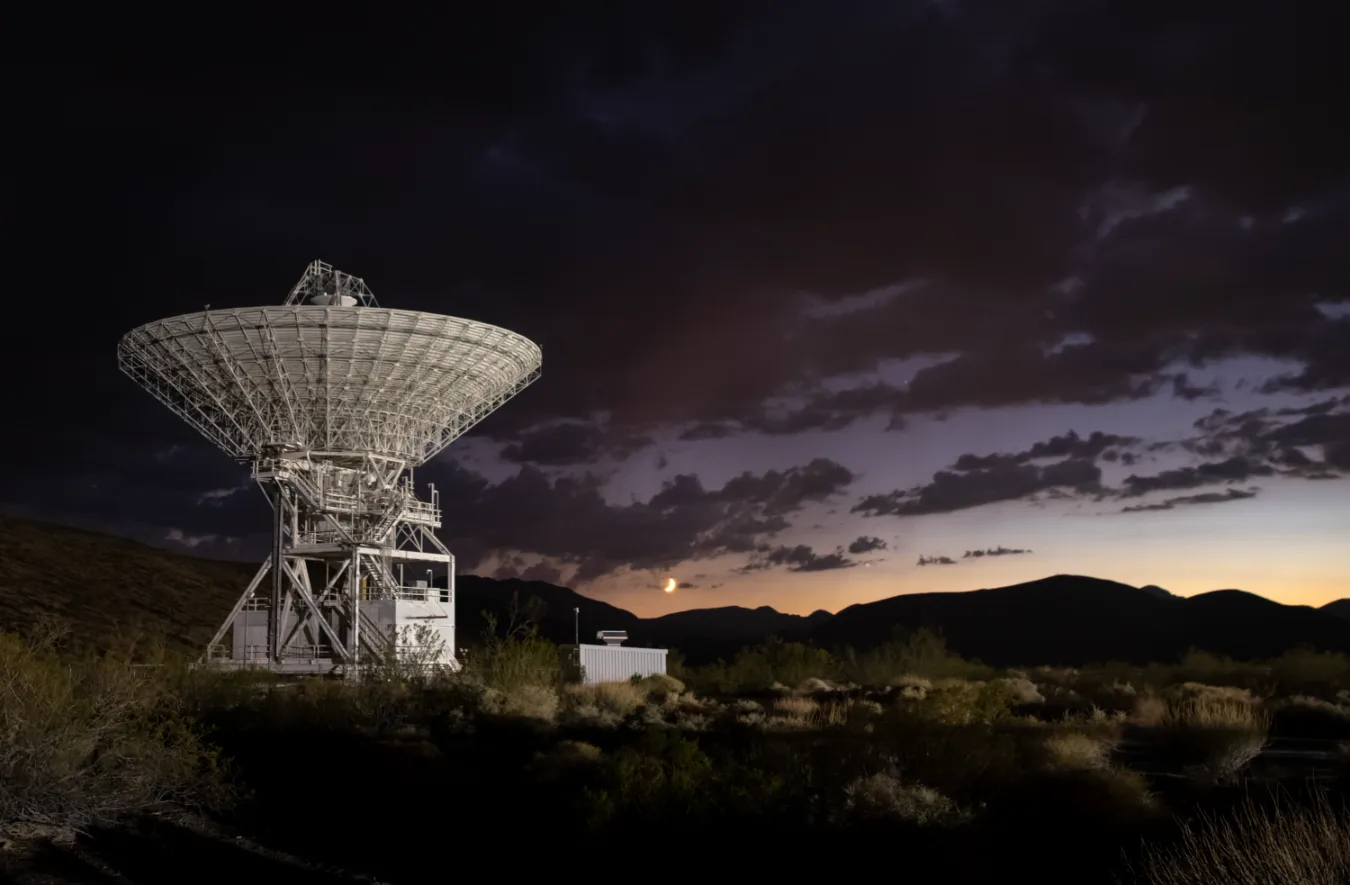
 Signals from an extraterrestrial intelligence could be so strong that they could be detected by existing infrastructure like the pictured antenna at the Goldstone Deep Space Communications Complex near Barstow, California. Image Credit: NASA/JPL-Caltech
 In December of 1612, while studying Jupiter and its moons with his telescope, Galileo observed a new star in the sky. Being more concerned with the planets in our solar system, he made a note of the observation and went about his work tracking Jupiter. But that star wasn’t a star at all. It was, in fact, Neptune – a planet as of then unknown to humanity. Although he was looking right at it, Galileo never lived to realize what Neptune really was. It would be another 230 years before scientists identified Neptune.
Moments like that highlight a recurring theme in science: sometimes discoveries emerge not from entirely new observations, but from looking at existing data in different ways or with new tools. Astronomical records collected for one purpose can later reveal something entirely unexpected when scientists rethink what they might contain.
A new study from a UCLA astronomer is challenging decades of conventional thinking in the search for extraterrestrial intelligence, arguing that scientists may need to rethink not only how they search for alien civilizations, but also how to interpret the fact that none have yet been found.
In a paper published April 15 in the Astrophysical Journal, UCLA astronomer Ben Zuckerman outlines a new “broadband SETI” approach — Instead of broadcasting weak signals in all directions, as many traditional searches for extraterrestrial intelligence (SETI) efforts assume, nearby civilizations would likely use powerful, highly focused transmissions aimed at specific nearby star systems, including Earth.
That shift in perspective has major implications.
“Astronomy has a long history of discoveries hiding in plain sight. SETI may be another case where the right question, asked of the right archival data, could change everything,” Zuckerman said.
Traditional SETI searches have largely focused on detecting faint radio signals broadcast in all directions over an extremely narrow range of wavelengths. But Zuckerman argues that this assumption may be misguided. A nearby advanced civilization, he suggests, would likely have access to far greater energy resources and would use directed beams to maximize the chance of detection, producing signals far stronger than those current searches are optimized to find.
Under this model, signals from nearby civilizations would not require specialized, ultra-sensitive searches. Instead, they could appear in the vast amount of data already collected by conventional astronomical surveys across radio, optical and, to a lesser extent, infrared wavelengths.
Over the past several decades, astronomers have conducted extensive sky surveys for purposes unrelated to SETI, mapping large portions of the electromagnetic spectrum with increasing sensitivity. According to Zuckerman, these datasets may already cover much of the “search space” needed to detect a nearby, intentionally communicating civilization. This is especially true at visible wavelengths, as scientists have published a large number of such surveys dating back over 100 years.
The absence of any such detections, then, becomes meaningful.
“Non-detections are not just null results,” Zuckerman said. “They can place real constraints on how many communicative civilizations exist near Earth.”
The paper goes further, offering rough upper limits on the number of such civilizations in the Milky Way. Based on current observations and the absence of detected signals or extraterrestrial probes, Zuckerman estimates that the number of communicative extraterrestrial civilizations is likely fewer than 100,000 — and possibly fewer than 10,000 — in a galaxy of hundreds of billions of stars.
Zuckerman emphasizes that more comprehensive searches are still needed, particularly across unexplored portions of the radio and infrared spectrum. Future efforts that combine broadband observations across multiple wavelengths could provide a more definitive answer. Ultimately, the paper proposes a shift in thinking — from asking how to find extraterrestrial intelligence to understanding what its apparent absence might already be telling us.
Could we, like Galileo 400 years earlier, be staring a world-changing discovery in the face but not realize it?