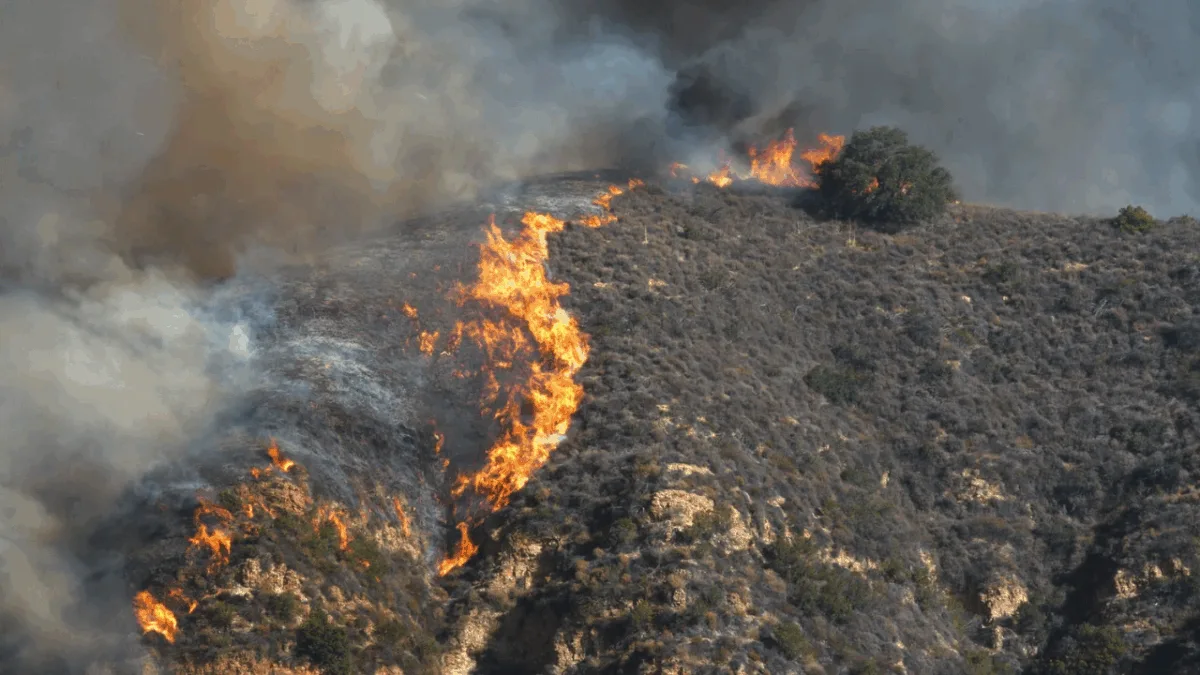
 The 2025 Southern California fires were compound hazards exacerbated by extreme weather, ecological conditions, and the Santa Ana winds. Image credit: UCLA Institute of Environment and Sustainability.
 As extreme weather has become more common due to climate change, so have hazards like droughts, heatwaves, and severe storms. Because they are happening more frequently, hazards are more likely to occur at the same time and place, often causing or exacerbating each other.
In a paper published in Nature Geoscience, UCLA Earth, Planetary, and Space Sciences Postdoctoral scholar Chuxuan Li, Professor Seulgi Moon, and collaborators outlined a pathway to more accurately predict these compound hazards using soil moisture data.
“Compound hazards are hazards that occur together or trigger the other in a cascading hazard chain,” said Li. Compound hazards, like heatwaves and drought happening at the same time or heavy storms triggering landslides, are becoming more common as climate change increases the frequency and intensity of extreme weather events.
Soil moisture, or the amount of water in soil, influences and is influenced by rainfall, temperature, amount and type of vegetation, and other environmental factors. “In separate hazards or individual hazards, soil moisture has been used as a predictor or an indicator… for example, a long-lasting soil moisture deficit can evolve into a drought,” Li said.
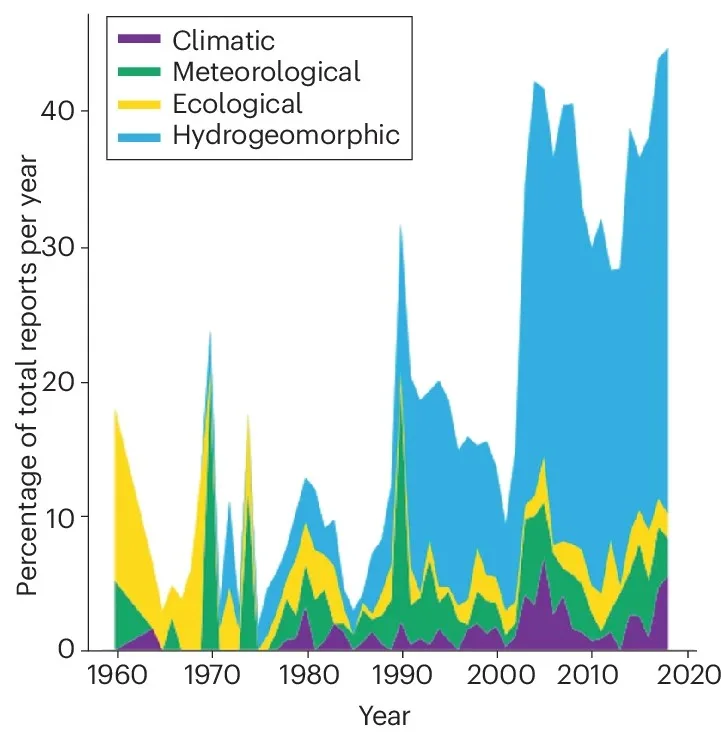
However, few hazard early warning systems incorporate soil moisture as a predictor or indicator for compound hazards, despite soil moisture being a critical player. “For example, when drought coincides with heatwaves, the drought and heatwaves can be more intense and prolonged,” said Li. “And these together will cause proportionally larger economic losses and impacts to society.”
Since a plethora of environmental conditions affect soil moisture, it can be a useful measure to capture how these conditions interact with each other and lead to additional hazards. “A predictive system without soil moisture incorporated in it might miss information that is critical for accurately predicting these compound hazards,” said Li.
The paper authors identified three main roadblocks to incorporating soil moisture data in compound hazard prediction models: a deficit of relevant soil moisture and hazard data, an inherent complexity in the problem, and insufficient collaboration between scientists in different disciplines.
Soil moisture is closely tied to the local environment, so data from one region isn’t always useful when making predictions about a different location. Even in a single location, scientists need data from many different conditions to make good predictions. The paper authors call for more soil moisture data collection in understudied regions in rural areas and the global south, while also advocating for more useful data collection methods paired with the specific conditions. “We have to have better data to better model the relationships between soil moisture and hazards,” said Li.
Soil moisture plays a vital role in ecology, meteorology, and geology. Scientists from each of these and many other related disciplines study and model soil moisture in different ways. Combining these approaches and studying how each approach interacts would increase accuracy, said Li. “One of the goals is to increase collaboration across disciplines — between data scientists and software engineers and researchers — when they develop these kinds of predictive systems for hazards.”
One such interdisciplinary initiative is the Center for Land Surface Hazards (CLaSH), which is funded by the National Science Foundation (NSF). Moon and Li are both part of this new collaboration between scientists from around the United States, which “confronts the challenge of understanding interconnections between hazards that can greatly magnify their effects.”
This work was a collaboration between scientists at UCLA, Northwestern University, University of Bern (Switzerland), ETH Zurich (Switzerland), Oak Ridge National Laboratory, Pacific Northwest National Laboratory, Florida Institute of Technology, Utrecht University (Netherlands), Montana Technological University, and University at Albany.
Tags: climate science, Research