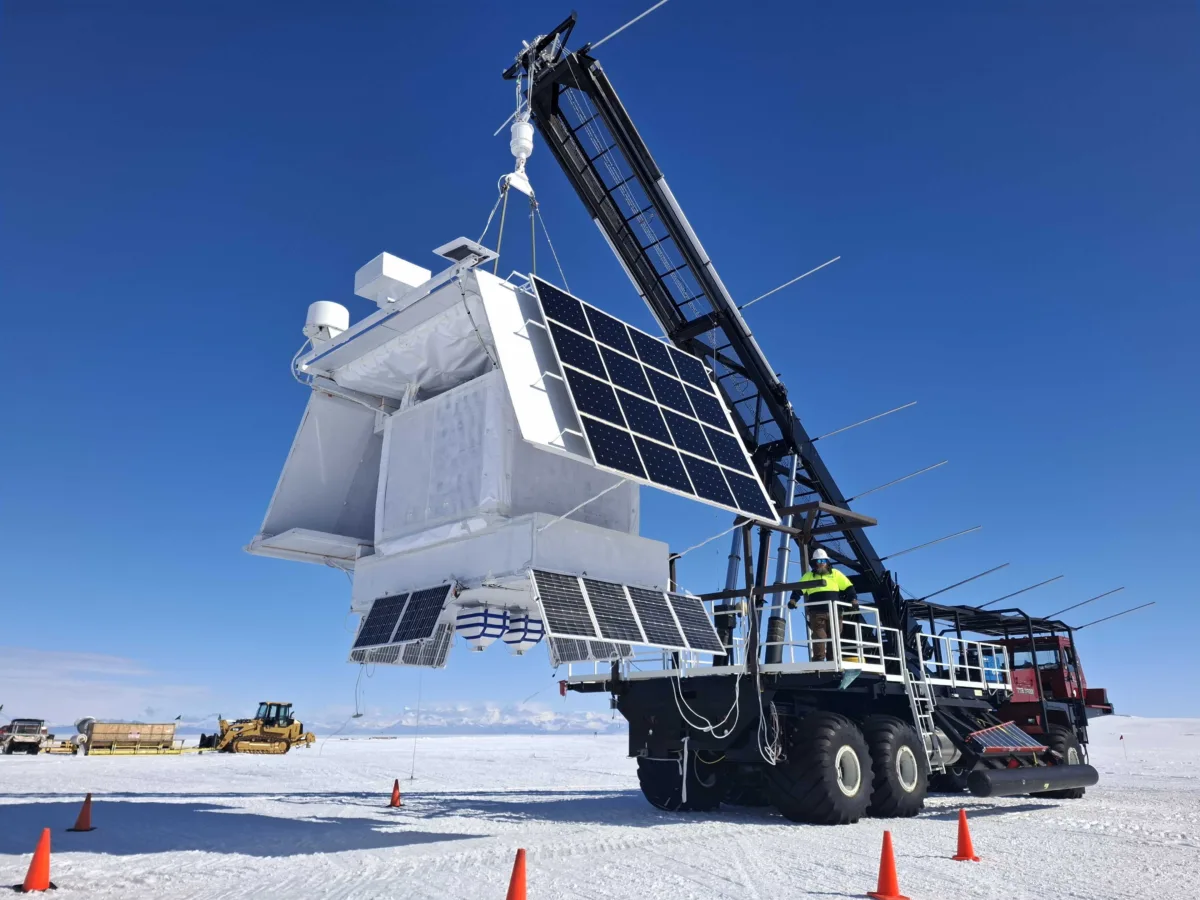
 The GAPS instrument being prepared for launch at the NASA Long Duration Balloon facility at McMurdo Station in Antarctica. Image credit: Florian Gahbauer.
 Data from an international collaboration to detect multiple types of theorized but unconfirmed antimatter particles that may form from dark matter were retrieved last month. This collaboration, the General Antiparticle Spectrometer (GAPS) experiment, involved flying a house-sized antiparticle detector attached to a football field-sized balloon over Antarctica for a month during December and January.
While some data were transmitted during the experiment, over 16 terabytes of data were stored on the instrument itself. The instrument landed near its launch site at the NASA Long Duration Balloon facility at McMurdo Station in Antarctica. Now, scientists are gearing up to analyze the data to answer a fundamental question: as UCLA professor Rene Ong puts it, “do these particles, the antideuteron or antihelium, even exist in nature?”
Antiprotons have been seen before in space, but larger antiparticles like antideuterons and antihelium have not. Deuterons are a heavier version of the hydrogen nucleus and consist of one proton and one neutron, while helium nuclei (also known as alpha particles) are made of two protons and two neutrons. The theorized but not-yet-detected antimatter counterparts of these nucleons, antideuteron and antihelium, would be negatively charged.
The discovery of even a handful of antideuterons by GAPS would be of great scientific importance, since there are no known ways to produce them with currently known physics. Thus, the detection of antideuterons would likely signal new physics, such as the annihilation of dark matter particles.
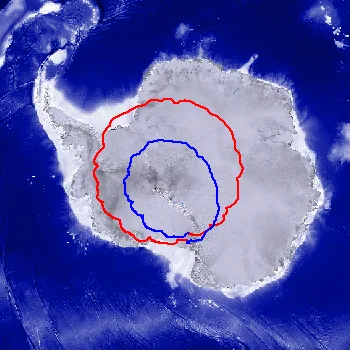
Because of the antiparticles’ charge, the Earth’s magnetic field and atmosphere would block them from reaching the surface. To have a chance at detecting the antiparticles, the instrument needed to be flown at one of the Earth’s poles and at a high altitude, necessitating the Antarctic balloon launch.
GAPS is the first experiment specifically designed to detect these antiparticles. Unlike prior general purpose magnetic-based detectors, GAPS is designed specifically for antimatter detection using a novel exotic atom scheme. Antiparticles are captured in the silicon tracker in GAPS when they displace an electron to form an exotic atom. The decay of this atom provides a unique signature of the antiparticle..
UCLA Physics and Astronomy Professor Rene Ong and his lab designed and built the Time of Flight (ToF) system, which is a large detector that surrounds the silicon tracker. The ToF measures incoming and outgoing particles and has the important task of selecting events that could be caused by incoming antiparticles, by filtering the much more prevalent events caused by ordinary particles.
Collaborators at institutions in the US, Japan, and Italy, were responsible for the other systems, and each country’s space agency (NASA, JAXA, & ASI), the INFN in Italy, and the US National Science Foundation (NSF) contributed funding to the project. Additional funding came from UCLA and the Heising-Simons Foundation.
“GAPS is a medium-sized particle physics experiment in space and it’s looking for rare particles amidst an enormously prolific background of stuff that’s not so interesting,” said Ong. The antinucleons are slower and lower energy than most of what hits the detector, so designing the system to only keep data of interest was vital. The ToF system built at UCLA “had to work perfectly… so I’m very proud of that, because it really did work well. And I’m proud of the team that did it.”
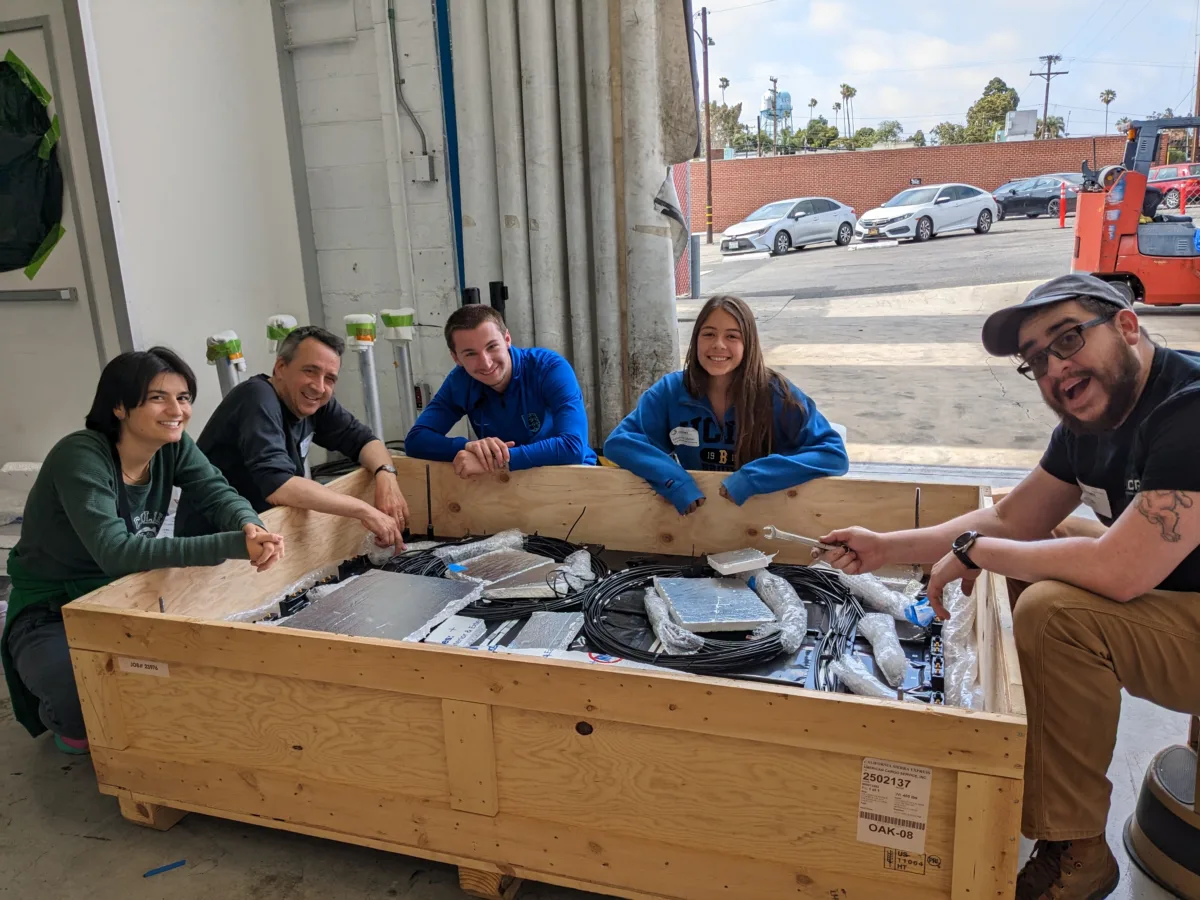
Undergraduate students worked on the construction and testing of the instrument. “They did a lot of the manual labor, but they also did a lot of the delicate construction and testing…many intricate steps were required that had to be done really well,” said Ong.
PhD students including Sydney Feldman and Padrick Beggs worked on the design, testing, and construction of the ToF system and its software. Feldman joined the project early — “she helped really deeply on the design aspects, the early testing, and getting things going,” said Ong.
“There are so many complex, interdependent, moving parts, and you have to be the expert on your own component and also understand how it fits in with every other component’s needs, capabilities, and physical footprint,” said Feldman. “It’s solving logistical issues, carefully documenting everything, accepting constraints and advocating for your team’s needs, all while making sure to take care dealing with both the human beings and specialized electronics that are necessary to get this thing in the air.”
After overcoming these challenges while working on GAPS, Feldman said, “I feel like I could pretty much do anything with my future.”
Beggs joined the project later and focused on the integration of the ToF system with the rest of the instrument. He went to Antarctica as part of the on-site team to launch the instrument in December. “Going to McMurdo Station, working nonstop trying to get this thing off the ground, and finally getting it off the ground was an incredible experience,” said Beggs. As a third-year graduate student, Beggs is “pumped to do some analysis,” over the next couple of years. “Now it’s time to actually do the science.”