Fault lines, and the earthquakes they cause, are never too far out of the mind of every California resident. Now new UCLA-led research suggests their impact on our world extends much farther than scientists previously recognized.
In a study published May 21 in Science, researchers from UCLA’s Department of Earth, Planetary and Space Sciences (EPSS) found evidence that active faults may weaken rocks over distances of up to about 100 kilometers, allowing landscapes to erode more easily over time. The work was led by Boontigan Kuhasubpasin, a former UCLA EPSS doctoral student and now a faculty member at the Chulalongkorn University in Thailand. UCLA EPSS professors Seulgi Moon and Carolina Lithgow-Bertelloni were co-advisors on the work. Moon is now a professor at ETH Zurich.
“We found that erosional efficiency increases substantially close to active faults and gradually decreases with distance,” Moon said. “The effect extends as far as around 100 kilometers from major fault systems.”
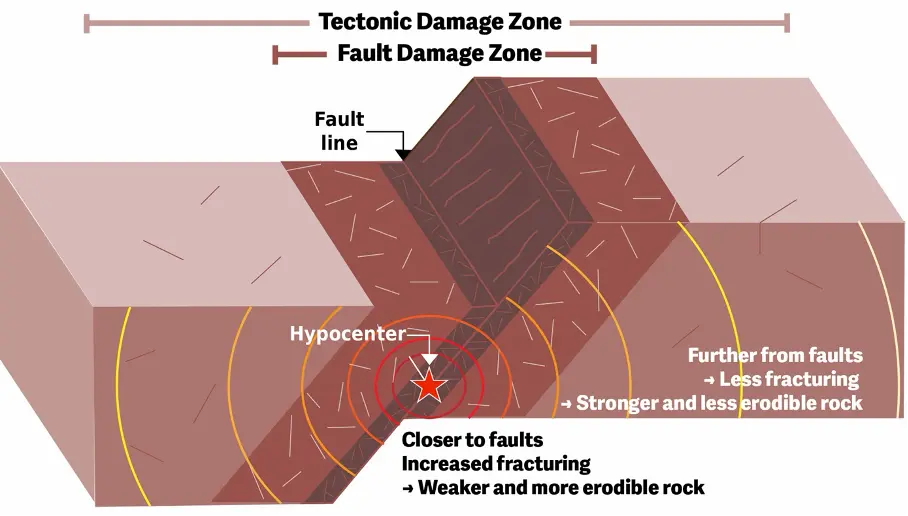
Scientists have long known that faults fracture and damage rocks immediately around fault zones. What has remained less clear is whether that damage influences landscapes at much larger scales — and whether it helps explain why tectonically active regions often erode more “efficiently” than quieter parts of Earth’s surface.
To answer that question, the UCLA team analyzed 1,744 measurements of erosion rates from river basins around the world. The measurements were derived from beryllium-10, an isotope that accumulates in quartz minerals exposed near Earth’s surface and can be used to estimate how quickly landscapes wear away over time.
The researchers compared those erosion-rate records with global maps of active faults, seismic shaking, precipitation, and rock type. They found a clear pattern: river basins closer to active faults tended to have higher erosional efficiency, meaning that the underlying rocks were easier to erode.
That influence was strongest within about 15 kilometers of a fault trace. Although the influence declined with distance, the researchers were still able to detect impact out to roughly 100 kilometers. The observed scale of the effect far exceeds the narrow damage zones traditionally associated with fault cores.
The findings suggest that faults shape landscapes in two ways. They do not only uplift mountains and alter river gradients. They also appear to contribute to widespread rock weakening over broad regions, having a more pronounced impact on erosion.
“We believe earthquake shaking may be a key reason for this phenomenon,” said Lithgow-Bertelloni. “Repeated shaking can open microfractures, weaken contacts between mineral grains and reduce the strength of near-surface rock. Over time, that damage may make rocks more vulnerable to river incision, landslides and chemical weathering.”
To test how important fault-related damage was compared with other environmental controls, the team used machine-learning models. Distance to active faults emerged as one of the strongest predictors of erosional efficiency, exceeding precipitation and lithology in many tectonically active regions, particularly when seismic-shaking data were included.
For California, the findings offer a new way to think about the relationship between earthquakes, rock damage and landscape change. The San Andreas and other active fault systems are not only sites of seismic risk; they are also part of a broader process that helps determine how mountains, valleys and river systems evolve.
The work has implications for understanding mountain building, sediment transport and natural hazards. In regions where tectonic activity has weakened rocks over large areas, hillslopes and river systems may respond differently to storms, earthquakes and long-term tectonic change than models have traditionally assumed.