 Photo Credit: Shawn Joseph Photography LLC
 Anshul Kogar, associate professor of physics and astronomy, has received a 2026 National Brown Investigator Award, a highly competitive honor that provides up to $2 million over five years to support ambitious, curiosity-driven research in the physical sciences. Kogar is one of eight researchers nationwide selected this year by the Brown Institute for Basic Sciences at Caltech.
The award will support efforts to address a question that has puzzled physicists for nearly four decades: How, exactly, do high-temperature superconductors work?
Superconductors are materials that can conduct electricity without resistance, eliminating the energy losses that occur in conventional electrical systems. Today, roughly 5% to 10% of electrical power is lost as heat while traveling through transmission lines. A practical superconductor that operates at everyday temperatures could dramatically improve energy efficiency and enable new technologies, from advanced medical imaging systems to more powerful computing and transportation systems.
“High-temperature superconductors remain one of the most important unsolved problems in condensed matter physics. This award gives us the freedom to pursue a challenging experiment that could place some of the strongest constraints yet on the theories that have been proposed to explain them.”
– Anshul Kogar
The challenge is that superconductivity typically occurs only at extremely low temperatures.
The first superconductor, discovered in 1911, functioned only a few degrees above absolute zero. Progress was slow until 1986, when researchers discovered a new class of copper-oxide materials that superconducted at much higher temperatures, sparking a revolution in condensed matter physics. Yet despite decades of research, scientists still do not fully understand how these materials work.
“High-temperature superconductors remain one of the most important unsolved problems in condensed matter physics,” Kogar said. “This award gives us the freedom to pursue a challenging experiment that could place some of the strongest constraints yet on the theories that have been proposed to explain them.”
At the heart of the project is an experiment proposed roughly 25 years ago by theoretical physicist Anthony Leggett that could reveal where energy is saved when a material transitions into a superconducting state.
Answering that question could help researchers distinguish among competing theories of superconductivity.
The reason the experiment has never been performed is simple: the required instrument does not exist.
Kogar’s team, in close collaboration with fellow UCLA physics professor Pietro Musumeci and his group, is building a new electron energy-loss spectrometer that combines three capabilities not previously achieved in a single system: operation at extremely low temperatures, exceptionally high energy resolution and momentum-space mapping. Together, these features would allow researchers to observe electronic phenomena beyond the reach of existing instruments.
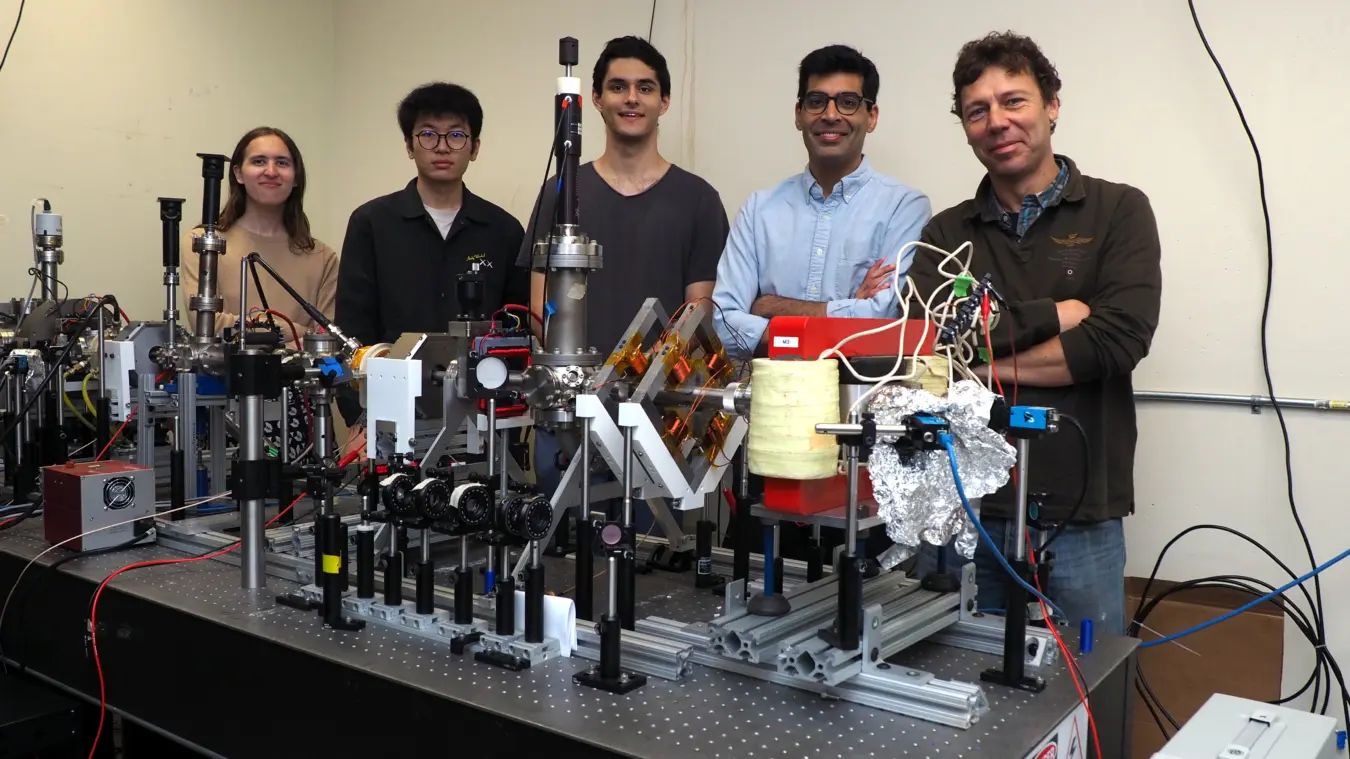
The project builds on a technique known as momentum-resolved electron energy-loss spectroscopy, or M-EELS, which Kogar helped develop earlier in his career and has used to study the collective behavior of electrons in quantum materials.
“The Brown Investigator Award is allowing us to build a completely new experimental tool,” Kogar said. “The instrument is the key enabling technology. Without it, this measurement simply isn’t possible. And building the instrument itself could not have been possible without the support of UCLA and professor Musumeci.”
Construction of the spectrometer is already underway in Kogar and Musumeci’s UCLA laboratory. The team expects development to continue over the next several years, with the goal of performing the experiment within the five-year duration of the award.
Success would not immediately produce a room-temperature superconductor. Instead, it would provide something equally valuable: a clearer understanding of the limits and possibilities of the materials scientists already know.
By identifying which theories are consistent with experimental reality and which are not, researchers could narrow the search for new superconducting materials and gain insight into whether substantially higher operating temperatures are achievable.
Kogar’s selection reflects the purpose of the National Brown Investigator Award, which supports recently tenured faculty pursuing fundamental questions in chemistry and physics that have the potential to generate long-term scientific advances. Universities across the country nominate candidates, who are then evaluated by an independent scientific review board. Caltech does not nominate its own faculty for the award.
“If we can make this measurement,” he said, “we’ll learn something fundamentally important about how these materials work. That’s the first step toward understanding what their ultimate potential may be.”