
Alvine Kamaha has long been a leading researcher in the search for dark matter. Now, she has played yet another pivotal role in that arena as a member of the LUX-ZEPLIN (LZ) dark matter experiment – a collaboration between 37 institutions from across the globe. That experiment just delivered the most sensitive direct search to date for elusive dark matter particles along with unprecedented glimpses of neutrinos from the Sun’s core.
Kamaha, assistant professor of physics at UCLA and the Keith and Cecilia Terasaki Endowed Chair in Physical Sciences, chairs the LZ Institutional Board and brings deep expertise in building and calibrating the world’s most sensitive dark matter detector. She has been central to overcoming the many technical challenges that make nearly background free detection possible, from ensuring detector cleanliness during assembly to refining how signals are calibrated and interpreted.
Dark matter, the invisible substance thought to make up about 85 % of the mass of the universe, has long evaded direct detection. Over more than a year of high-quality data taking, LZ has now set world-leading limits on how often weakly interacting massive particles (WIMPs) might interact with ordinary matter, narrowing the space where such particles could hide. While no definitive dark matter signal has yet appeared, these results are the most stringent ever for certain mass ranges, pushing the frontier of discovery further than ever before.
“In an era when uncovering dark matter could reshape our understanding of the universe, Professor Kamaha’s work helps strengthen UCLA Physical Sciences as a driving force in the global search for dark matter.”
Miguel Garcia-Garibay, Dean of UCLA Division of Physical Sciences
“We are in discovery territory, and there is a large swath of physics phenomena that LZ can now access with greater sensitivity,” Kamaha said, reflecting both on LZ’s dark matter search and its broader physics reach. “In addition to WIMPs and boron-8 solar neutrinos, LZ’s exceptional sensitivity also enables the exploration of a broad range of other rare physics processes beyond the Standard Model, including the inaugural search for millicharged particles in an underground xenon experiment and the search for cosmic-ray-boosted dark matter, both of which were spearheaded by my two postdoctoral researchers, Dr. Yongheng Xu and Dr. Dongqing Huang, and published in Premiere Science Journals and Physical Review Letters.”
The experiment’s sensitivity has also allowed the first direct detection of solar neutrinos via coherent scattering, providing a new window into processes deep within the Sun’s core. These neutrinos generate faint signals that mimic those expected from dark matter. LZ’s ability to both constrain WIMP interactions and measure these rare neutrino processes marks a major technical and scientific milestone.
LZ is scheduled to collect over 1,000 days of live search data by 2028, more than doubling its current exposure. With that enormous and high-quality dataset, LZ will become more sensitive to dark matter at higher masses in the 100 GeV/c2 to 100 TeV/c2 (teraelectronvolt) range. Collaborators will also work to reduce the energy threshold to search for low-mass dark matter below 3 GeV/c2, and search for unexpected or “exotic” ways that dark matter might interact with xenon.
Kamaha’s involvement with LZ goes back to its construction phase, where she co-led efforts to keep the detector free of contamination that could otherwise mimic or obscure potential dark matter events. She also led the installation and commissioning of calibration systems essential to distinguishing real signals from background noise.
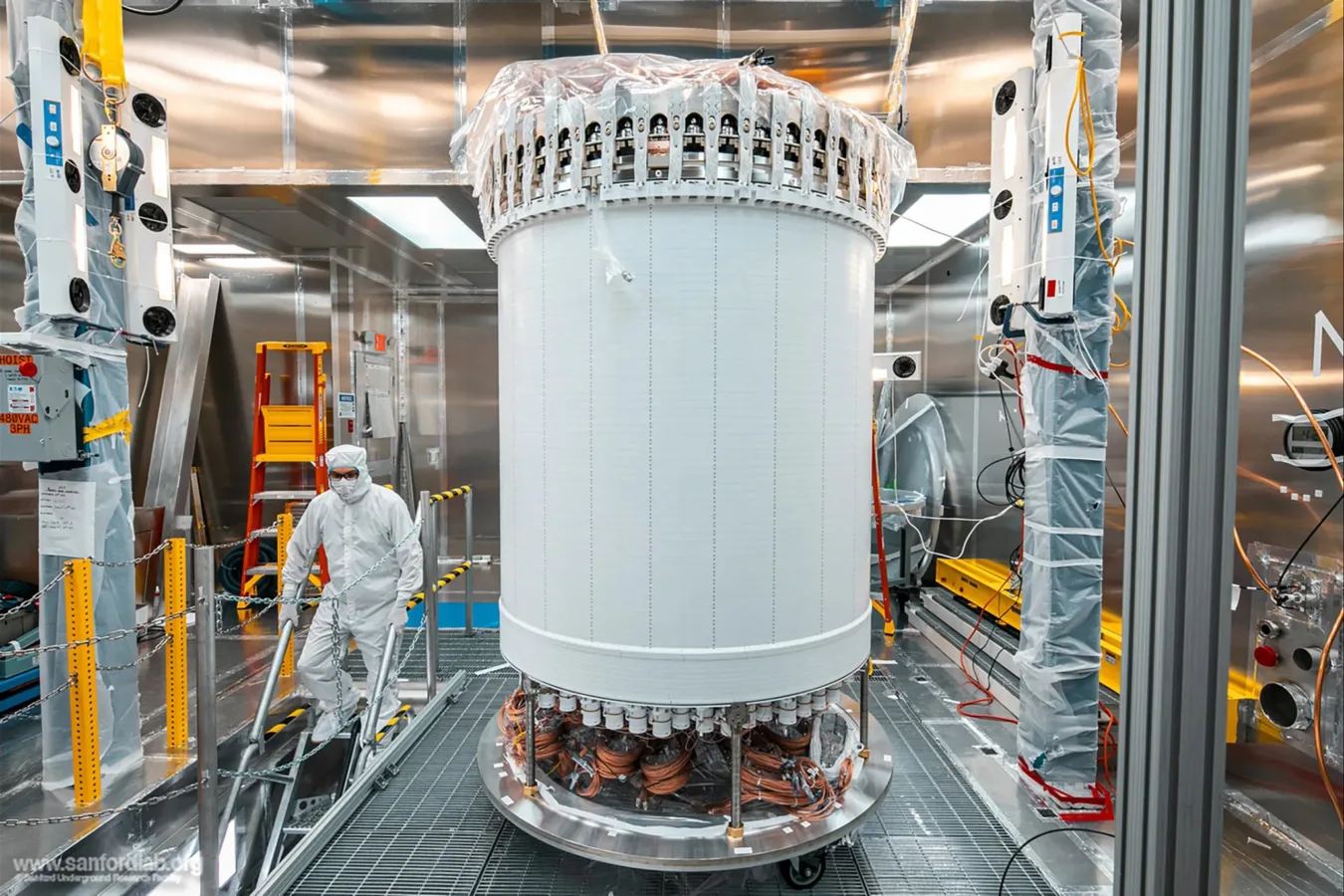
Credit: Matthew Kapust/Sanford Underground Research Facility
Her broader work focuses on calibration and background control techniques that aim to enhance dark matter xenon detector sensitivity worldwide. Kamaha’s UCLA research group, ExCaliBUR, develops new approaches to optimize detector performance and reduce false positives — efforts that are crucial as experiments push deeper into unexplored territory in the quest to reveal dark matter’s nature.
Earlier in her career, Kamaha’s contributions earned her the American Physical Society’s Edward A. Bouchet Award, recognizing her leadership in experimental dark matter research and her role in expanding opportunities for underrepresented scientists.
While a dark matter particle discovery remains elusive, the new LZ results — and the strategies Kamaha has helped build — are guiding future searches with unmatched precision. The experiment plans to collect several more years of data, increasing its sensitivity across a broad range of hypothetical dark matter models and even exploring unexpected types of rare physics signals.
“In an era when uncovering dark matter could reshape our understanding of the universe, Professor Kamaha’s work helps strengthen UCLA Physical Sciences as a driving force in the global search for dark matter,” said Dean of UCLA Physical Sciences Miguel Garcia-Garibay. “As one of the field’s rising stars, her contributions ensure that UCLA is not only participating in some of the most ambitious scientific efforts of our time, but actively defining how the search is conducted.”
______
LZ is supported by the U.S. Department of Energy, Office of Science, Office of High Energy Physics, and the National Energy Research Scientific Computing Center, a DOE Office of Science user facility. LZ is also supported by the Science & Technology Facilities Council of the United Kingdom; the Portuguese Foundation for Science and Technology; the Swiss National Science Foundation; the Australian Research Council Centre of Excellence for Dark Matter Particle Physics; and the Institute for Basic Science, Korea. Thirty-seven institutions of higher education and advanced research provided support to LZ. The LZ collaboration acknowledges the assistance of the Sanford Underground Research Facility.