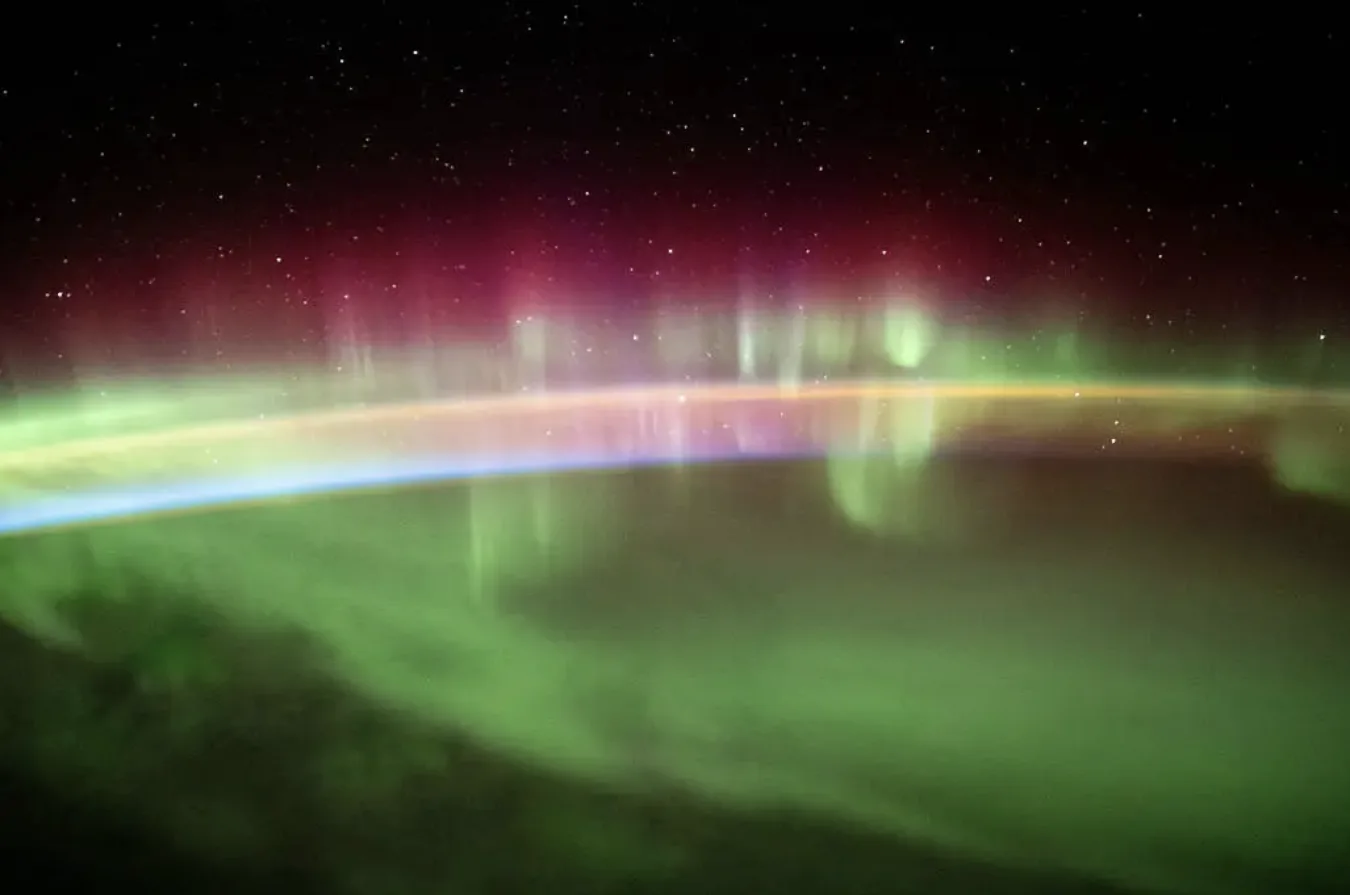
In a major advance for space science, a team led by UCLA researcher Dr. Sheng Tian has uncovered new evidence explaining the phenomenon of auroral arcs — a visualization of narrow bands of electric fields that form along Earth’s magnetic field above the upper atmosphere. Understanding this phenomenon, known for the colorful arcs seen near the poles, has important implications for understanding Space Weather. The findings, published in Nature Communications, help solve a long-standing mystery and could reshape how scientists understand auroras and space weather both on Earth and other planets.
Tian’s research could help improve forecasting of space weather events that affect satellites, power grids, and communications infrastructure. They also highlight the value of coordinated satellite missions and offer a roadmap for future spacecraft mission designed specifically to study these energy processes.
“This study includes co-authors with diverse scientific backgrounds from UCLA, the University of Minnesota, and institutions in Canada and Hong Kong. It is only by combining our expertise with the robust data from government satellites that we were able to achieve this goal.” – Dr. Sheng Tian
The discovery was made possible by the fortunate alignment of three government space physics missions: NASA’s twin Van Allen Probes (RBSP-A and RBSP-B), the U.S. Air Force’s DMSP, and the ground aurora imagers of the NASA’s THEMIS mission. Tian and his colleagues spent months combing through archival data to find a moment where the satellites passed through the right region of space simultaneously and long enough to capture critical measurements.
Auroral arcs are typically visible from the ground as green, shimmering curtains sweeping across the polar sky. But from space, they appear as thin, glowing lines. The team studied one such arc, observed in both hemispheres at once, allowing for a detailed look at the energy dynamics along the magnetic field line that produces the light.
Scientists have long known that auroras originate in an “acceleration region” above the arc, where a strong electric field—or equivalently a potential drop—propels electrons into Earth’s atmosphere. But how this electric field forms and remains stable in space’s dynamic plasma environment has remained a mystery.
“This region is like a space-based electric circuit,” Tian explained. “Charged particles should neutralize such fields quickly, but that’s not what is happening. Until now it’s been unclear how these potential drops persist.”
The answer, the team found, lies in Alfvén waves—low-frequency plasma waves named after Nobel laureate Hannes Alfvén. Their analysis supports the theory that these waves deliver the energy needed to sustain the electric field over time, effectively powering the aurora.
Beyond Earth, the findings can help scientists interpret auroras observed on Jupiter, Saturn, and even distant exoplanets and comets. If Alfvén waves power potential drops on Earth, similar mechanisms may be at work elsewhere in the universe. And if that is true, it gives future explorers a better understanding of how to approach studying these faraway bodies.
“This kind of field-aligned acceleration appears to be a universal process,” Tian said. “But Earth is the one place where we can study it in such detail.”
While the discovery advances basic science, it also has a more down-to-earth application: aurora forecasting. By improving our understanding of how and where these potential drops form, researchers can refine models that predict when and where auroras will appear. That means better forecasts for photographers, travelers, and night sky enthusiasts eager to witness the northern or southern lights.
Tian is quick to point out the importance of collaborative research supported by government technology. “This study includes co-authors with diverse scientific backgrounds from UCLA, the University of Minnesota, and institutions in Canada and Hong Kong,” he said. “It is only by combining our expertise with the robust data from government satellites that we were able to achieve this goal.”