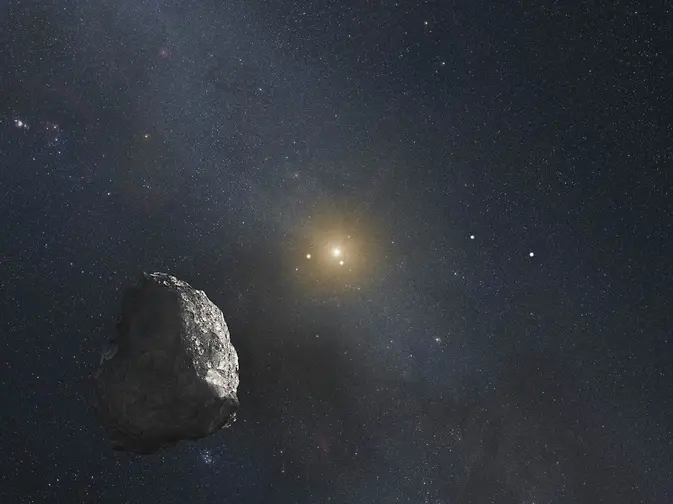
 Artist’s rendition of a Kuiper Belt object located 4 billion miles from the Sun. Credit: NASA, ESA, and G. Bacon (STScI)
Scientists from UCLA and NASA have identified evidence of an ancient reservoir of water ice in the Kuiper Belt, a distant region beyond Neptune. Their findings, based on microscopic cosmic dust particles collected high in Earth’s atmosphere, provide new insight into how water was distributed during the formation of the solar system.
The research, published in Science Advances, identifies a distinctive isotopic signature in particles originating in the outer solar system, providing evidence of a water reservoir whose existence scientists had long suspected but struggled to establish.
Ming-Chang Liu, a researcher in UCLA’s Department of Earth, Planetary, and Space Sciences, led the oxygen isotope measurements, working with UCLA Research Professor Kevin McKeegan and NASA scientists Lindsay Keller and Christopher Snead.
“These are extraordinary particles, and studying them requires capabilities that no single laboratory has,” said Liu. “NASA’s expertise in collecting and examining cosmic dust, combined with the isotope measurements we can perform at UCLA, gives us a way to investigate materials that have preserved evidence of the solar system’s earliest history.”
Oxygen has three stable isotopes, ¹⁶O, ¹⁷O and ¹⁸O. Variations in their relative abundances provide clues about where planetary materials originated and how they evolved. For decades, scientists have predicted that water in the early solar system should be depleted in ¹⁶O, the most abundant isotope, relative to rocky material, in a way that ordinary chemical reactions cannot produce. Until now, researchers had only limited evidence of this ancient water and little certainty about where it was located.
“This research shows that water in the early solar system was not distributed or mixed uniformly,” said McKeegan. “The isotopic differences preserved in these tiny particles tell us something important about how the solar system developed, and how the formation of the giant planets may have influenced the movement of material between its inner and outer regions.”
The team examined 12 interplanetary dust particles, each far smaller than the width of a human hair. Collected in Earth’s stratosphere by NASA high-altitude aircraft, the particles’ origins were traced through microscopic damage tracks left by energetic particles from the Sun. Their unusually high track density indicates prolonged exposure consistent with an origin in the distant Kuiper Belt.
At NASA’s Johnson Space Center, Keller and Snead examined the particles’ mineral structures and chemical compositions, finding evidence that their original materials had reacted with water. At UCLA, Snead, Liu and McKeegan used a highly sensitive ion microprobe (CAMECA ims-1290) to measure oxygen isotopes within the particles, revealing an isotopic signature distinct from that of most meteorites originating closer to the Sun.
By comparing the water-altered minerals in the particles with their likely original minerals, the researchers calculated the composition of the water responsible for the alteration. Their results indicate that the water was strongly depleted in ¹⁶O, providing compelling evidence of a primordial water reservoir in the Kuiper Belt.
The distinctive isotopic signature found in these particles is largely absent from meteorites, suggesting that the distant reservoir remained relatively isolated as the planets formed.
The researchers propose that the formation of the giant planets, particularly Saturn and possibly Uranus and Neptune, may have restricted the inward transport of water-rich material from this distant reservoir. Such barriers could help explain why different regions of the solar system developed distinct isotopic compositions, offering new insight into the processes that shaped the planets and other bodies billions of years ago.
The study, “A Primordial Heavy Water Reservoir in the Outer Solar System,” was authored by Lindsay P. Keller and Christopher J. Snead of NASA’s Johnson Space Center and Ming-Chang Liu and Kevin D. McKeegan of UCLA’s Department of Earth, Planetary, and Space Sciences. UCLA’s ion microprobe facility receives partial support from the National Science Foundation.