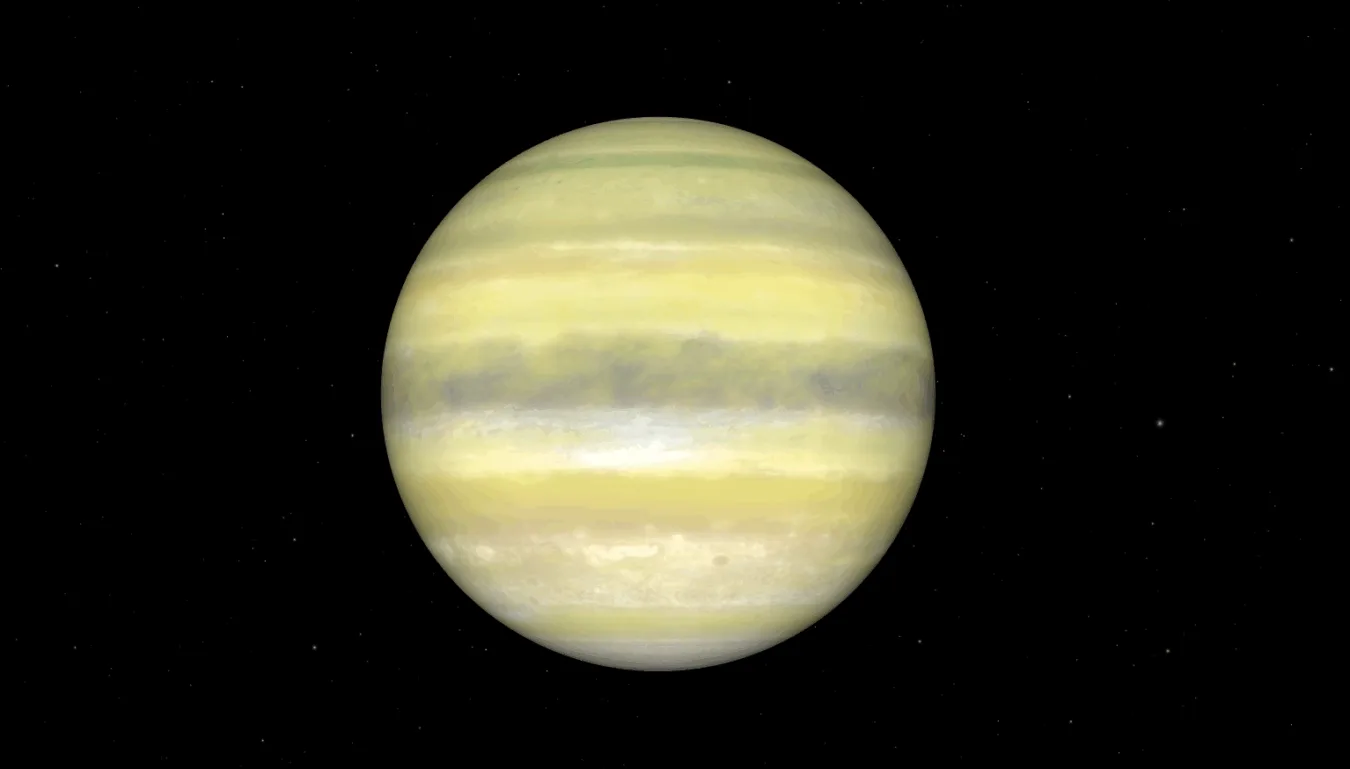
 An artistic representation of hazy exoplanet LP 791-18 c. (Credit: NASA Eyes on Exoplanets)
 A UCLA-led team using the James Webb Space Telescope (JWST) has uncovered a striking example of how deceptive first impressions can be. LP 791-18 c, a small, temperate sub-Neptune orbiting a cool red dwarf 86 light-years away, initially appeared to be an ideal “planetary twin” to several well-studied exoplanets of similar size and temperature. But the new observations show that this world is anything but a twin. Instead, it possesses an atmosphere that diverges dramatically from expectations.
Led by new UCLA post-doc Pierre-Alexis Roy, the research changes the established expectations astronomers had for what to expect when studying sub-Neptune exoplanets. The findings were published last week in Nature Astronomy.
The planet’s size and surface temperature suggested it would resemble other temperate sub-Neptunes observed with JWST, which typically show clear cloud-free atmospheres rich in methane and carbon dioxide. But when the team analyzed LP 791-18 c’s spectrum, the data told a completely different story. Instead of a clean, molecule-rich atmosphere, the planet appears veiled in a thick photochemical haze — with strong methane but no detectable carbon dioxide. This haziness muted the molecular features astronomers normally rely on to categorize such worlds.
“What we see is that while two planets can look identical from afar, their chemistry can reveal completely different origins,” said Pierre-Alexis Roy, lead author on the paper. “LP 791-18 c shows us that similar size and temperature are nowhere near enough to predict what a sub-Neptune’s atmosphere will be like.”
Equally important, the team verified that the unusual signal wasn’t caused by the Red Dwarf star the planet orbits. Red dwarfs often produce spots and flares that can interfere with atmospheric measurements, but even after modeling those effects, the atmospheric signature remained unchanged. The haze and methane-rich chemistry truly belong to the planet. This makes LP 791-18 c one of the clearest demonstrations yet that sub-Neptunes of nearly identical physical characteristics can still diverge dramatically in cloudiness, chemistry, and atmospheric clarity.
The planet’s unusual composition also offers clues to its origin. The lack of oxygen-bearing molecules and the abundance of methane hint that LP 791-18 c may have formed inside the water-ice line of its early planetary system — a region too warm for icy grains to survive. Planets forming farther out generally accumulate more water and other volatiles, leading to CO₂-rich atmospheres. LP 791-18 c appears to have been built from drier, carbon-heavy material, and its atmosphere still bears the imprint of that ancient environment.
The surrounding system adds even more to the intrigue. Another planet in the same planetary system, the Earth-sized LP 791-18 d, is believed to undergo intense volcanism triggered by gravitational interactions, making it one of the most promising “volcano world” candidates known. The fact that such different worlds orbit the same small star underscores an emerging theme in exoplanet science: planetary diversity can be extraordinary, even among neighboring planets.
Although LP 791-18 c is not a habitable world, its scientific value is immense. The planet broadens the known range of what sub-Neptunes can be and challenges long-standing assumptions about their uniformity. “With the help of JWST, we have shown that what look like ‘planet twins’ can in fact be completely different worlds, shaped by very different histories,” said professor Björn Benneke, co-author on the paper and Roy’s PhD advisor. “This is a major step forward in helping us better understand the universe and the formation of planets.”