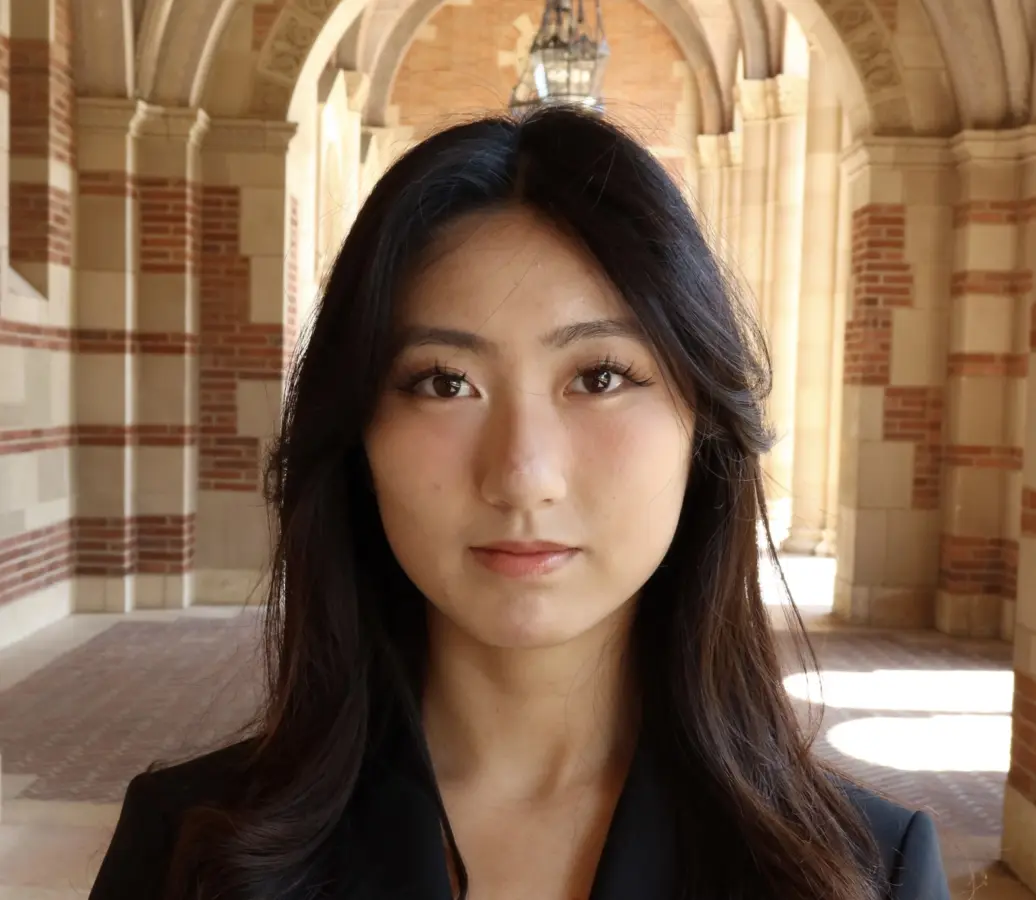
Chloe Cheng is a physics student at UCLA who attended Exploring Physics at UCLA, an event organized by the student-led Continuum Club to connect aspiring physicists with researchers in the field. Below, she shares how the event broadened her perspective on scientific research and communication, and what she’s learned about collaboration and finding her place in the physics community.
What brought you to Exploring Physics at UCLA, and what did you take away from the experience?
I was initially drawn to Exploring Physics because of its focus on undergraduates. When I first came to UCLA, I received a lot of advice about finding research opportunities, such as talking to professors or attending colloquia. While helpful, much of today’s research is so complex and specialized that it can be difficult for a newcomer to join the conversation. Most research talks are geared toward experts in their fields.
Exploring Physics filled that gap by encouraging researchers to explain their work to a broader audience.
I found Professor Levenson-Falk’s discussion of superconducting circuits particularly fascinating. He introduced the ideas through concepts familiar to introductory physics students, building toward more complex topics while explaining them along the way. That made the discussion more interesting because, once I understood the main points, I could come up with better questions.
One thing I’ve noticed is that the science and engineering community doesn’t always place as much emphasis on teaching and communication as it could. Researchers develop tremendous expertise, but they don’t necessarily spend as much time learning how to explain their work to people outside their fields.
The talks showed me the value of learning to communicate your work alongside doing the research itself, something I hope to carry forward in my career. I’ll admit I haven’t always enjoyed putting in the effort to explain complicated ideas. But there’s real value in being able to explain what you do, whether to students, the media or someone simply asking about your work.
This connects to Dr. Krishna Choudhary’s discussion of storytelling in science. A well-thought-out explanation can make a tremendous difference in how interested someone becomes in a subject. It certainly did for me.
Did anything you heard or experienced at the event change or expand the way you think about studying physics and where it might take you?
When I first chose to major in physics, I knew the field offered many interdisciplinary opportunities, but it wasn’t always easy to see what those actually looked like.
Dr. Choudhary’s talk about neurophysics brought that idea to life. He showed how physical models can be used to discover patterns in biological data, and I was particularly interested in his point that you don’t necessarily need extensive knowledge of another field to begin working on an interdisciplinary research topic.
That challenged some advice I’d heard before, where students are encouraged to study physics alongside a more applied field, such as medicine, engineering or economics, to make sure their education is “useful.” His discussion showed me that physics itself can take you surprisingly far into another subject.
For students like me who haven’t decided what to specialize in, that’s encouraging. It gives us more freedom to explore what we genuinely enjoy studying.
Now that you’re studying physics at UCLA, what do you wish you had known about the field, or about studying physics at a university, before you arrived here?
I wish I’d known just how collaborative studying physics would be, even outside of lab courses that require group work.
In high school, I usually studied alone, and while that worked at the time, I can’t imagine approaching my studies that way now. During exam season, it’s easy to organize a study session in one of the communal spaces, but it took me time to get comfortable with that.
In the media, scientists are often portrayed as people who lock themselves away in a basement and somehow revolutionize the world without talking to anyone. In reality, you need to talk to your peers, professors and mentors.
I hadn’t realized how important it would be to vocalize my thoughts while working through a problem. Sometimes my friends build on my ideas, and other times something clicks after I hear myself explain it out loud.
The physics community at UCLA is very supportive. I didn’t fully take advantage of that until later in the year, and I wish I’d approached things with that mindset from the beginning.
I also struggled with imposter syndrome when I started, and I wouldn’t say I’ve completely overcome it. Physics brings you into contact with incredibly talented people studying complicated subjects. When research isn’t explained accessibly, it can make you feel even more out of place.
But that shouldn’t discourage you from pursuing research. As an undergraduate, you’re not expected to understand everything about a subject before you begin.
I arrived at UCLA thinking I needed to feel comfortable with a topic before pursuing independent projects or research. Now I realize that so much of the learning happens along the way. Maybe I’ll never feel 100% comfortable with what I’m working on, and that’s okay. That sense of not knowing is part of what pushes me forward. After all, physics is about discovery.