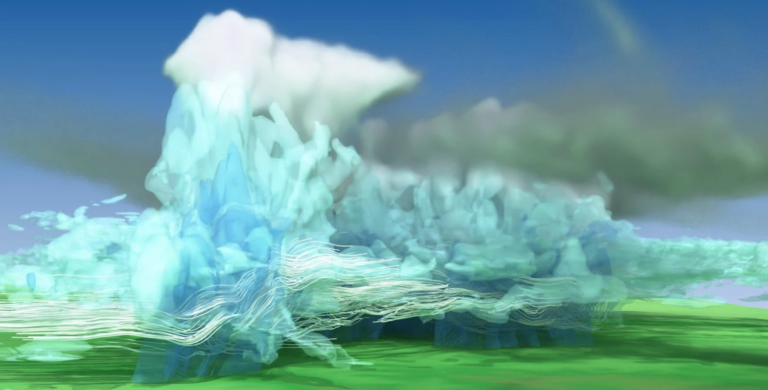
 Visualization of a simulated storm cloud showing cloud ice, water, rain and complex airflow patterns. Courtesy of the HD(CP)² project, Max Planck Institute for Meteorology.
 UCLA planetary scientist Jonathan Mitchell will lead UCLA’s role in a new $3 million international research project examining one of the most complex features of planetary atmospheres: clouds.
The three-year project, directed by University of Texas at Austin astronomer Caroline Morley, is one of 12 Targeted Simons Research Groups selected for funding by Simons Foundation International and administered by the Simons Foundation. The team will study the physics of clouds across a wide range of planetary environments, bringing together scientists from Earth climate science, planetary science and astrophysics.
Mitchell, a professor of Earth, planetary, and space sciences at UCLA, is one of nine principal investigators at institutions across the United States and Europe. As UCLA’s principal investigator, he will recruit and advise a new postdoctoral researcher devoted to the project, as well as two UCLA graduate students whose participation Mitchell helped secure as part of the collaboration.
“We have an opportunity to treat clouds as a fundamental physics problem rather than something belonging to one particular field.”
– Jonathan Mitchell
Rather than concentrating researchers at a single institution, the project will establish a network of postdoctoral scholars distributed among participating universities and research centers. The researchers will work closely across institutional lines, with principal investigators serving as secondary advisers to postdocs based elsewhere. Mitchell’s UCLA postdoc, for example, will also have an adviser at Princeton University, while Mitchell will help advise two postdoctoral researchers at other institutions.
“This is a very different model from the way large research projects are usually organized,” Mitchell said. “We’re building a group where the postdocs and their advisers are deliberately connected across institutions and disciplines. The idea is to create sustained interaction among people who might otherwise approach clouds from very different directions.”
Clouds are a familiar part of Earth’s atmosphere, but the physics governing their formation and behavior remains extraordinarily difficult to model. Even relatively small differences in how clouds are represented — including their altitude and how much energy they reflect or trap — can significantly affect climate predictions.
Those questions become even more challenging beyond Earth, where clouds can form under vastly different temperatures, pressures and chemical conditions. The project will examine cloud physics across different spatial and temporal scales and planetary environments.
“We have an opportunity to treat clouds as a fundamental physics problem rather than something belonging to one particular field,” Mitchell said. “By looking across planets and across scales, we can ask which processes are universal, which depend on a particular environment and what these very different worlds can teach us about our own.”
The collaboration grew out of a Simons Symposium where researchers from different disciplines began discussing the cloud problem. Their conversations highlighted the central role clouds play in predicting changes in Earth’s climate and the potential value of studying the same fundamental processes across very different planetary environments.
The international team includes researchers from UCLA, the University of Texas at Austin, the University of Maryland, the University of Chicago, the Geophysical Fluid Dynamics Laboratory, Oxford University, Leiden University and the Max Planck Institutes for Meteorology and Astronomy, among other institutions. Its work will combine theoretical studies and simulations with observations, including data from NASA’s James Webb Space Telescope.
The project’s distributed structure is designed to make its postdoctoral researchers a central link between those institutions and areas of expertise, allowing them to work with multiple advisers and move ideas between fields.