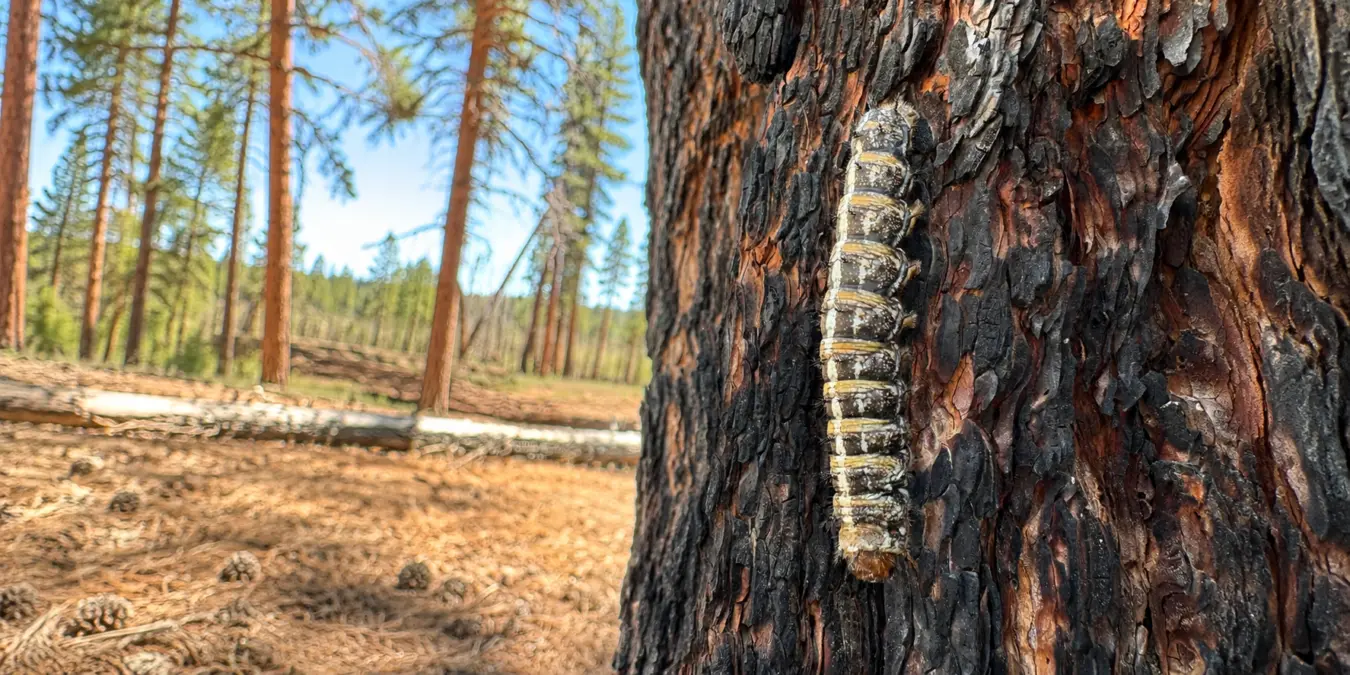
 Photo Credit: Jeff Holmquist
 For 75 years, UCLA’s White Mountain Research Center has provided scientists with a living laboratory for studying some of California’s most distinctive mountain ecosystems. Many of the discoveries made there have depended on something increasingly rare in scientific research: decades of observation in the same landscape.
Now, researchers at the White Mountain Research Center, which is part of UCLA’s Institute of the Environment and Sustainability and UC Nature, have uncovered new details about one of the eastern Sierra’s most remarkable natural events—the brief descent of Pandora moth caterpillars from Jeffrey pine trees to the forest floor. Their findings offer new insight into the insects’ two-year life cycle while building on previous research showing how a traditional harvesting practice may also help reduce wildfire damage around trees.
Published recently in Western North American Naturalist, the study focuses on a key stage of the Pandora moth’s life cycle. Every other summer, thousands of caterpillars descend the trunks of Jeffrey pines before disappearing beneath a layer of fallen pine needles, where they remain as pupae for nearly a year before emerging as moths.
“This research really has come from the heart. Nobody was chasing funding or trying to create a particular kind of collaboration. We were asking questions together because they were interesting and important.”
– Jeff Holmquist
Researchers found that once the caterpillars begin their descent, they have roughly an hour to reach the forest floor and burrow beneath the pine needles before predators, parasites and environmental conditions dramatically reduce their chances of survival. The findings also suggest that rising temperatures may make that already narrow window even more challenging in the years ahead.
“This is really a race to the bottom,” said Jeffrey Holmquist, resident researcher at UCLA’s White Mountain Research Center and lead author of the study. “Everything in the forest seems to be trying to eat them.”
Pandora moths are among the largest forest insects in North America. During their descent, the caterpillars must evade birds, rodents, ants and parasitic flies and wasps before reaching the protective layer of pine needles that shelters them through the next stage of their development.
For decades, foresters viewed Pandora moths primarily as a pest because the caterpillars consume large quantities of pine needles. While severe outbreak years can occasionally stress already weakened trees, healthy Jeffrey pines generally withstand the feeding. The insects also play an important ecological role and have long served as a valuable seasonal food for the Nüümü People. During productive years, families historically harvested 200 to 300 pounds of caterpillars over a two-week period, providing a rich source of fat and protein that could be eaten fresh or preserved for later use.
The findings are the result of a collaboration that has developed over more than a decade among White Mountain researchers, Nüümü Elders and Youth, and the U.S. Forest Service. Rather than beginning with a grant proposal or formal initiative, the project emerged through conversations about traditional stewardship practices and the ecological questions they raised.
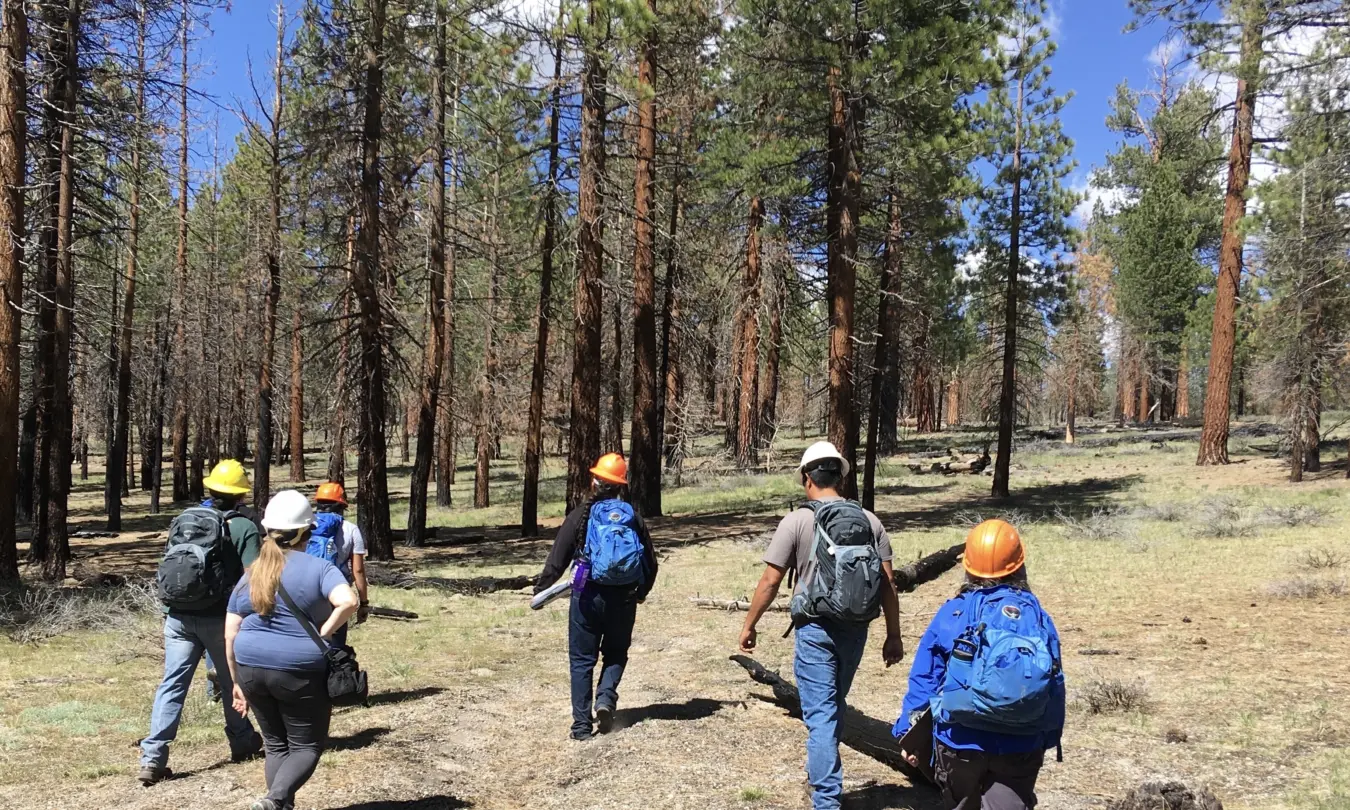
“It has really come from the heart,” Holmquist said. “Nobody was chasing funding or trying to create a particular kind of collaboration. We were asking questions together because they were interesting and important.”
Those conversations led researchers to another discovery.
Before harvesting the descending caterpillars, Nüümü families traditionally clear pine needles, fallen branches and other forest debris from around the base of Jeffrey pines, creating a clean, trenched area where the insects can be more easily collected. Tribal collaborators, the U.S. Forest Service, and White Mountain researchers established an experiment to test whether those cleared areas also influenced how trees responded to wildfire.
Before a planned prescribed burn to test that theory could take place, a real wildfire swept through the study area.
That unexpected fire became a natural experiment. Last year, the research team reported that trees managed using the traditional harvesting practice suffered significantly less fire damage than untreated trees, demonstrating that reducing fuels around the base of individual trees might contribute to their chances of surviving wildfire while also supporting a long-standing food-harvesting tradition.
By documenting exactly how the insects move from tree to forest floor, researchers hope to better understand how changing environmental conditions could affect both the species and the forest ecosystems they inhabit. Hotter temperatures appear to cause caterpillars to travel across the ground more quickly, forcing them to expend valuable energy as they race to escape predators and burrow beneath the pine needles. As mountain climates continue to warm, researchers suspect those challenges could become more pronounced.
For Holmquist, the study demonstrates why long-term field stations remain indispensable. “Many ecological questions cannot be answered during a single grant cycle or field season,” he said. “Understanding the Pandora moth required following an insect with a two-year life cycle, documenting a natural event that unfolds over little more than an hour every other summer, and building long-term relationships with collaborators over many years.”
Seventy-five years after the White Mountain Research Center was established, that combination of sustained observation, field-based research and strong local partnerships remains one of the center’s most important advantages.