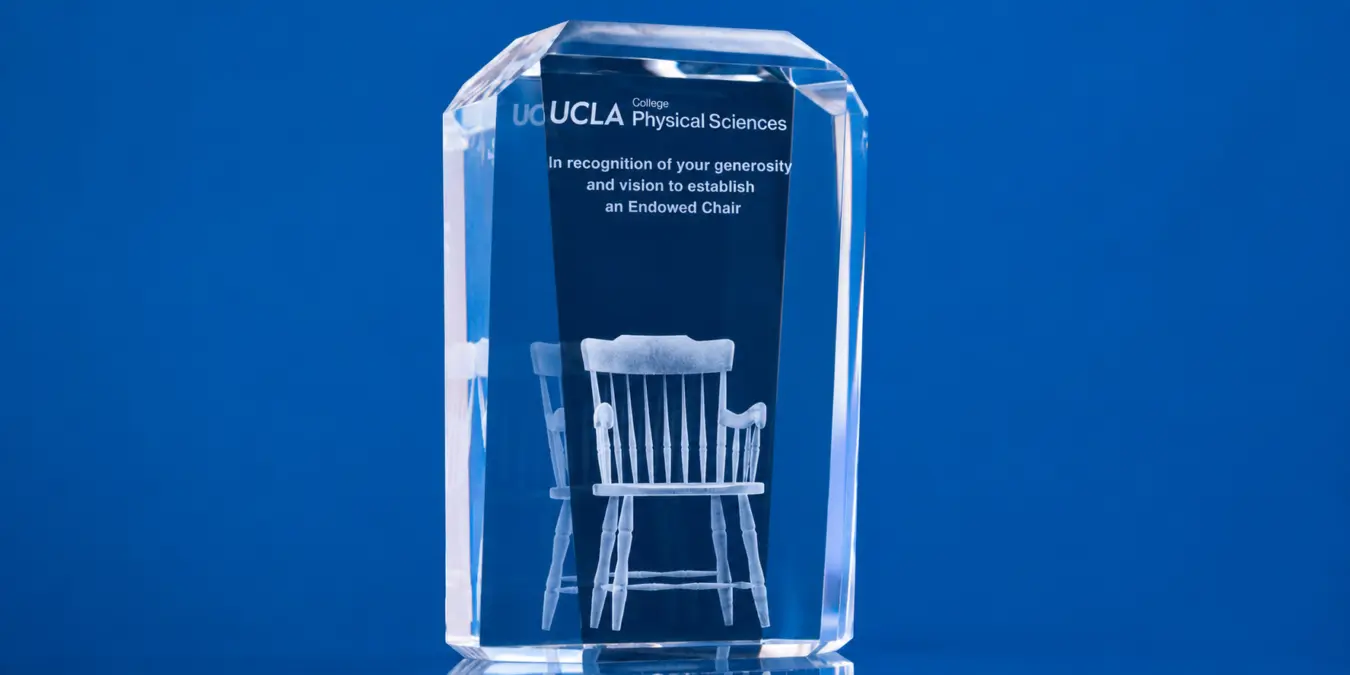
Modern society runs on data. Understanding how that data is collected, analyzed and interpreted has become one of the defining scientific challenges of our time. That vision inspired UCLA alumnus Kirk Dunn (’83) and his wife, Huifen, to establish the Dunn Family Endowed Chair in Data Theory, strengthening a field that bridges mathematics, statistics and computation while supporting the next generation of researchers and students.
Dunn, who earned his bachelor’s degree in Mathematics and Applied Science from UCLA, is the founding chair of the Data Theory Board of Advisors and played an instrumental role in developing the interdisciplinary major shared by the Departments of Statistics & Data Science and Mathematics. Establishing the endowed chair grew out of watching mathematics become central to advances in artificial intelligence, medicine, communications and countless other fields.
“When I was an undergraduate in the 1980s, the focus was on engineering disciplines and computer science,” Dunn said. “Today, I encourage young people to study mathematics, applied mathematics and data theory. We are in the age of data, knowledge, intelligence and reasoning, making these fields more important than ever.”
The Dunn Family Endowed Chair arrives at a time of remarkable momentum for UCLA Statistics & Data Science. Home to the world’s first undergraduate major in the mathematical and statistical foundations of modern data science, the department has emerged as one of the nation’s leading statistics and data science programs, rising from No. 19 to No. 12 in the latest national rankings.
Dunn Family Endowed Chair in Data Theory: Mark S. Handcock

A Distinguished Professor of Statistics, Mark S. Handcock has spent his career developing statistical methods that reveal hidden patterns in complex social and environmental systems. His research spans social networks, demography, social epidemiology and spatial processes, creating new approaches that help researchers better understand everything from human behavior to population health.
The endowed chair provides him the flexibility to pursue emerging research opportunities while continuing to shape UCLA’s academic leadership in one of its fastest-growing disciplines.
“Because UCLA pioneered the world’s first Data Theory major, combining rigorous, proof-based mathematics with advanced computational statistics, this appointment gives me the platform to ensure our academic programming continues to evolve,” Handcock said. “It allows us to equip the next generation of scholars and industry leaders with the deep conceptual foundations required to shape the future of data science, rather than just react to it.”
Handcock said the chair also strengthens the close partnership between UCLA’s Departments of Statistics & Data Science and Mathematics, where Data Theory was established as a truly interdisciplinary field. Long-term philanthropic investments like the Dunn Family Chair help attract exceptional students and faculty while providing the flexibility to pursue ambitious research, strengthen academic programs and respond to new scientific opportunities as they emerge.
While the technologies built on data continue to evolve at a remarkable pace, the mathematical principles that underpin them remain constant. By investing in those enduring ideas, the Dunn family’s gift helps ensure UCLA continues preparing students not only to understand the next generation of data-driven technologies, but to help create them.