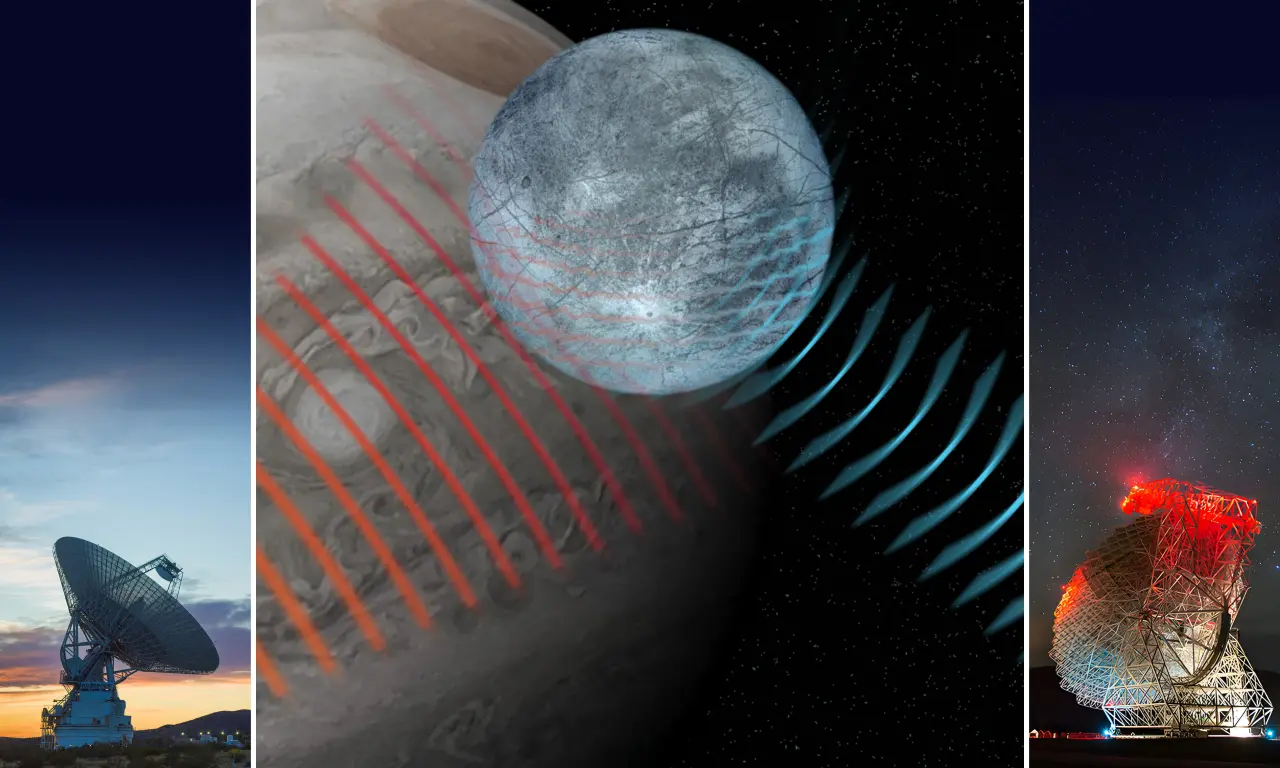
 This artist’s impression shows radar waves from the NASA Goldstone Solar System Radar pinging one of Jupiter’s moons, Europa. The radar waves penetrate Europa’s icy surface before bouncing back to be collected by the NSF Green Bank Telescope on Earth.
Credit: NSF/AUI/NSF NRAO/P.Vosteen
This artist’s impression shows radar waves from the NASA Goldstone Solar System Radar pinging one of Jupiter’s moons, Europa. The radar waves penetrate Europa’s icy surface before bouncing back to be collected by the NSF Green Bank Telescope on Earth.
Credit: NSF/AUI/NSF NRAO/P.Vosteen A team of scientists has used NASA’s Goldstone Solar System Radar and the U.S. National Science Foundation Green Bank Telescope (NSF GBT) to carry out the most extensive radar study to date of Europa, the ocean world orbiting Jupiter. By repeatedly “pinging” Europa with 3.5‑centimeter radio waves between 2011 and 2024, the team measured how the moon reflects radar signals and confirmed that its icy surface scatters radio energy in an unusually strong and complex way not seen on rocky worlds.
Led by professor Jean-Luc Margot and UCLA Astronomy graduate student Tunhui Xie, the results were submitted this week to the Planetary Science Journal. Xie will present the results today at the American Astronomical Society meeting.
Three of Jupiter’s big moons, Europa, Ganymede, and Callisto, are especially interesting to scientists because they have icy outer shells and are thought to hide oceans of liquid water underneath. Of these three, Europa is a prime target in the search for habitable environments beyond Earth. Geologic features provide clues to how the ice shell and underlying ocean interact, but these features only reveal what is happening at or near the surface. Explains Tunhui (Tina) Xie, a graduate student working with Professor Jean-Luc Margot at the University of California Los Angeles, “Radar delves below what is easily seen, because radio waves can penetrate into the ice, and carry information about its internal structure and purity.”
These new observations show that Europa’s radar “albedo”—a measure of how bright it appears to radar—is much higher than that of typical planets and asteroids. The returning radar signal is dominated by the same circular polarization as the transmitted beam, a hallmark of multiple scattering inside clean, porous ice. These properties strongly support an explanation known as the “coherent backscatter opposition effect,” in which radio waves bounce around within the ice before returning back to the telescope, dramatically boosting the echo.
Because the team observed Europa in a bistatic configuration—with Goldstone transmitting and both Goldstone and the NSF GBT receiving—they could also test how the coherent backscatter effect changes with the angle between transmitter, moon, and receiver. They found that Europa’s radar brightness stayed roughly constant even when the angle increased, implying that the bright backscatter “peak” must be broader than the range of angles they sampled, placing a limit on the depth that the radio waves diffused before being absorbed. This depth limit offers a new constraint on how transparent Europa’s ice is, and will help scientists interpret upcoming ice‑penetrating radar data from spacecraft now en route to study this moon in more detail.
These new ground‑based results fill a three‑decade gap since the last major radar study of Europa in the late 1980s and early 1990s. The researchers find strong agreement between their measurements and those earlier results, reinforcing the picture of Europa as an object with very high radar reflectivity and strongly “diffuse” scattering, rather than the mirror‑like reflections seen from many rocky surfaces. This consistency increases confidence that Europa’s radar properties are stable over time and that Earth‑based and spacecraft radar measurements can be interpreted within a unified physical framework.
Because the observing campaign spanned many years and viewing geometries, the team asked whether Europa’s radar brightness changed from one hemisphere to another, or with longitude. They found that Europa’s disk‑integrated radar properties are statistically consistent with remaining nearly constant as the moon rotates, which agreed with earlier observations.
However, when the authors divided the data into leading and trailing hemispheres and performed statistical tests, they saw a hint—though not statistically conclusive—that the trailing hemisphere could be slightly brighter in one polarization state. If confirmed with future data, that subtle difference could be related to how charged particles from Jupiter’s magnetosphere modify the ice or affect the formation of small‑scale surface structures that absorb or scatter radio waves.
“Future planetary science and space flight missions, like NASA’s Europa Clipper, could benefit from this type of radar science,” shares Will Armentrout, a scientist with the NSF NRAO who supports radar projects. “As the Green Bank Telescope’s radar capabilities evolve, with new technologies currently under development, we’re looking forward to providing even more radar capabilities for the scientific community.”
This news is featured in a press conference at the American Astronomical Society’s 248th meeting on Tuesday, June 16th at 10:15am PDT. Find a recording from this presentation on the AAS Press Office YouTube channel.