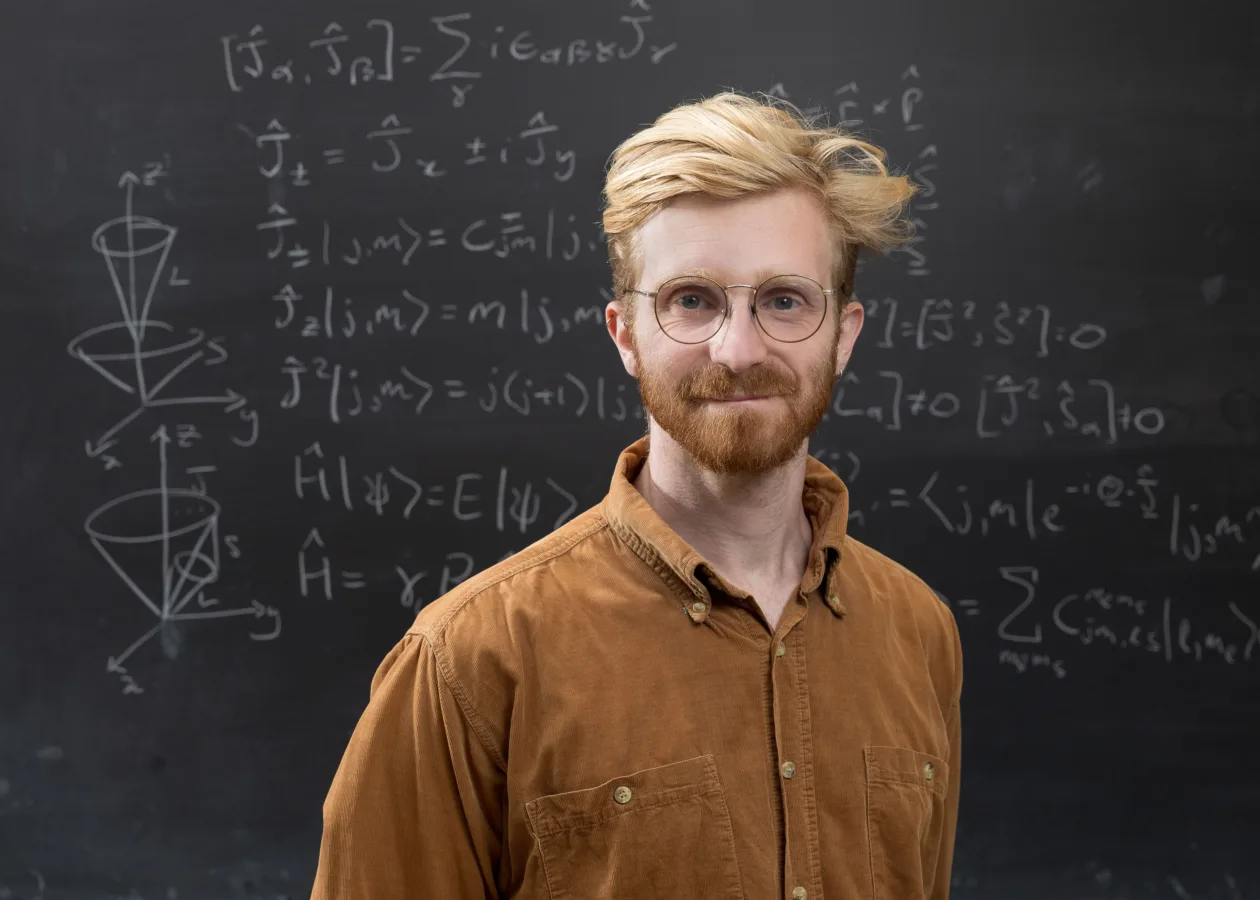
Thomas Fay is a professor of chemistry and biochemistry and one of the newest faculty members to join UCLA Physical Sciences. He is part of a rising cohort of researchers whose work reflects the division’s commitment to advancing fundamental science and improving education. Though he has only been at UCLA for a few months, he has already published several research papers. In one especially important theoretical paper, published in The Journal of Physical Chemistry Letters, Fay helps shed light on one key question about life’s origins: how a consistent molecular “handedness” could emerge from pre-biotic chemistry in the early years of our planet.
“All biomolecules that make up biological organisms, such as proteins and DNA, have ‘handedness’ like left and right hands. Identical but not superimposable,” he said. These molecules are known as “chiral molecules” and, in ordinary non-chiral chemistry, reactions that create chiral molecules typically produce equal amounts of right-handed and left-handed versions. This process is thought to be important to the emergence of life on Earth because it is needed for the production of regular, stable structures like proteins and nucleic acids.
Fay’s work draws on a phenomenon known as chirality-induced spin selectivity, or CISS. In this effect, chiral molecules interact differently with electrons depending on the electrons’ quantum spin. “In relatively recent chemical physics there has been a lot of exploration of CISS,” he said. “Experiments have shown that chiral molecules preferentially transfer one spin state over another.” In other words, quantum mechanics may play a role in the creation of these molecules.
Experiments suggest that CISS can act as a kind of filter for electrons by spin. Fay and his colleagues asked whether the effect could also work in reverse. Could spin polarization help create an imbalance between mirror-image molecules in the first place?
The paper proposes that it can. Fay explained that highly reactive intermediates, known as radical pairs, contain unpaired electrons. “If radical pairs start out with their electrons mostly in one spin state, their reactions can favor making one ‘hand’ of a molecule more than the other.” He used theoretical models to show how this kind of spin bias could, in principle, lead to a preference for one molecular handedness.
Although the mechanism still needs to be tested experimentally, it offers a possible path toward homochirality under early Earth conditions. If accurate, it could help explain how the earliest molecular building blocks gained the uniform orientation needed for life to develop. It could also inform the search for life beyond Earth by suggesting that planets containing iron or magnetic minerals might favor similar reactions.
“For the chemistry of life to get started, we first need a group of molecules which all have the same handedness,” he said. “This work points to a possible way nature could have achieved that remarkable feat with the help of quantum mechanics, long before life as we now recognise it emerged.”
Work in quantum chemistry may appear far removed from everyday experience, yet it can reshape how scientists understand the origins of life and the conditions that support it. For UCLA Physical Sciences, bringing in scholars like Fay represents a major investment in expanding the division’s strength at the intersection of quantum science and chemistry.